 EN
ENVisual explanations of algorithms and data structures. Explore Bloom Filters, Consistent Hashing, Trie Trees, HyperLogLog, Count-Min Sketch, and more through animations and diagrams.
 中文
中文通过动画和图解,拆解复杂算法与数据结构的核心原理。从布隆过滤器、一致性哈希、Trie 树到 HyperLogLog、Count-Min Sketch,用最直观的方式理解计算机世界。
 EN
ENDynamic Programming is one of the most powerful—and most misunderstood—algorithmic techniques.
 中文
中文动态规划是算法中最重要、也是最容易让人困惑的主题之一。本系列通过大量动画、可视化推导和经典案例,从递归、记忆化搜索开始,逐步讲解状态设计、状态转移、DP 表构建以及各种经典动态规划模型,帮助你真正理解动态规划,而不是死记模板。
 EN
ENVisual Algorithms: Trees
 中文
中文图解算法:树与二叉树
 中文
中文🪐 宇宙图解 用直观的动画和动态图解,探索太阳系、行星、恒星以及更广阔的宇宙。从行星大小对比、轨道运动和引力原理,到航天探索、天文发现和宇宙奥秘,每一集都将复杂的科学知识转化为清晰易懂的视觉体验,让你轻松理解我们所处的宇宙。
 EN
EN🪐 Cosmic Explained brings the Solar System and the universe to life through engaging animations and motion graphics. Explore planets, stars, gravity, orbital mechanics, space exploration, and the latest astronomical discoveries with clear, visually driven explanations. Every episode transforms complex space science into intuitive stories that are easy to understand and enjoyable to watch.

 EN
ENVisual Algorithms: Heap

 EN
ENVisual Algorithms: Hashing
 中文
中文用清晰直观的动画,从零理解数据结构与算法。每集只讲一个结构或算法:先看朴素做法贵在哪里,再一步步演示它如何降低代价,最后比较时间复杂度、空间复杂度和实际取舍。系列按六个主题展开:字符串算法、树、堆、图、哈希,以及概率数据结构;从 KMP、Boyer–Moore 到 Dijkstra、红黑树、布隆过滤器和 HyperLogLog,帮助你建立可迁移的直觉,而不只是背下代码。
 EN
ENUnderstand data structures and algorithms from first principles through clear, intuitive animations. Each episode focuses on one structure or algorithm: what the straightforward approach costs, how the key idea reduces that cost, how the operations work step by step, and what the time and space complexity really is. The series is organized into six themes—string algorithms, trees, heaps, graphs, hashing, and probabilistic data structures—with episodes on KMP, Boyer–Moore, Dijkstra, red-black trees, Bloom filters, HyperLogLog, and more. Build transferable intuition instead of just memorizing code.
中文用可视化动画理解字符串算法如何避免重复工作。本播放列表从 KMP、Boyer–Moore 和 Rabin–Karp 开始,逐步讲解前缀匹配、从右往左跳跃、滚动哈希、多模式匹配、Trie 与回文查找,并比较每种方法在速度、空间和适用场景上的取舍。每集从一个具体例子出发,带你看清算法的运行过程、复杂度,以及它们为什么适合搜索框、文本搜索等实际问题。
ENSee how string algorithms avoid doing the same work twice through clear, step-by-step animations. Starting with KMP, Boyer–Moore, and Rabin–Karp, this playlist explores prefix matching, right-to-left skipping, rolling hashes, multi-pattern search, tries, and palindrome detection. Each episode uses a concrete example to show the algorithm in motion, then compares its time and space complexity, design trade-offs, and practical uses in search boxes and text search.
 中文
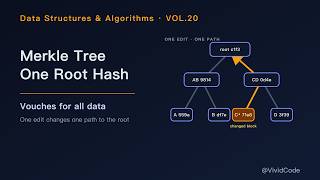
中文用可视化动画理解树是怎么把有序数据一直查成 O(log n) 的。从二叉搜索树开始:左小右大让查找沿一条路径走到底,而按顺序插入又会让它退化成链表——这是 AVL、红黑树、跳表、Treap 和笛卡尔树各自给出的答案要解决的问题。后半部分转向另一类问题:Fenwick 树和线段树回答区间求和与区间修改,区间树找出所有时间冲突,Merkle 树用一个哈希值担保整份数据。每集从一棵具体的树出发,演示插入、删除和旋转的每一步,再比较时间复杂度、空间复杂度和实际取舍。
 EN
ENSee how trees keep ordered data searchable in O(log n), through clear step-by-step animations. It starts with the binary search tree: smaller left, larger right means each search walks one path — until sorted inserts turn the tree into a list, which is the problem AVL trees, red-black trees, skip lists, treaps and Cartesian trees each answer differently. The second half turns to ranges: Fenwick trees and segment trees for prefix sums and range updates, interval trees for every clashing appointment, and Merkle trees, where one hash vouches for all the data. Each episode works through one concrete tree, insertion, deletion and rotation step by step, then compares time and space complexity and the trade-offs behind each design.
 中文
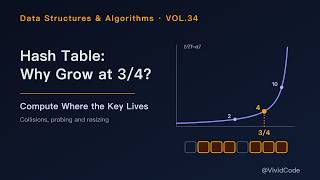
中文用可视化动画理解哈希表怎样从 key 直接算出位置,以及冲突之后怎么办。先从哈希表本身讲起:拉链把撞在一起的 key 挂成一串,开放寻址往后找空位;表越满查得越慢,而且是突然变慢,这就是 Java 的 HashMap 装到四分之三就扩容的原因。接下来三集都是开放寻址的改进:Robin Hood 哈希让离家更远的 key 抢走离家近的座位,把探测距离拉平;跳房子哈希规定每个 key 离家不超过 H 格,空位太远就把它一格格跳回来;布谷鸟哈希给每个 key 两个家,占了就踢走原住户,查询最坏也只看两格。每集都用几个能手算的 key 把插入、查找和删除走一遍,再比较时间复杂度、空间复杂度和实际取舍。
 EN
ENSee how a hash table computes where a key lives, and what it does when two keys want the same slot, through clear, step-by-step animations. It starts with the hash table itself: chaining hangs colliding keys in a list, open addressing probes on for a free slot, and a table gets slower as it fills, suddenly so, which is why Java's HashMap grows at three-quarters full. The next three episodes each improve on open addressing: Robin Hood hashing lets the key furthest from home take a nearer key's seat, evening out probe distances; hopscotch hashing keeps every key within H slots of home, hopping a distant empty slot back step by step; and cuckoo hashing gives every key two homes, kicking out whoever is there, so a lookup never reads more than two slots. Each episode runs insert, lookup, and delete on a handful of keys you can check by hand, then compares time, space, and practical trade-offs.